
How it's made
Kitomo is created and directed by Mario Hernández. He decides the concept, the world, each corner of the workshop and each final cut, and his decisions are recorded with their dates.
A workshop made of code
The whole workshop is built in 3D as one continuous space, in code in Blender: the geometry, the materials, the rolling physics, the mechanisms, the light and the camera.
The ball makes a single journey in each episode, and its exact position carries over across every cut. The cameras always stay on the same side of the path, so the ball enters each corner from the left and leaves on the right.
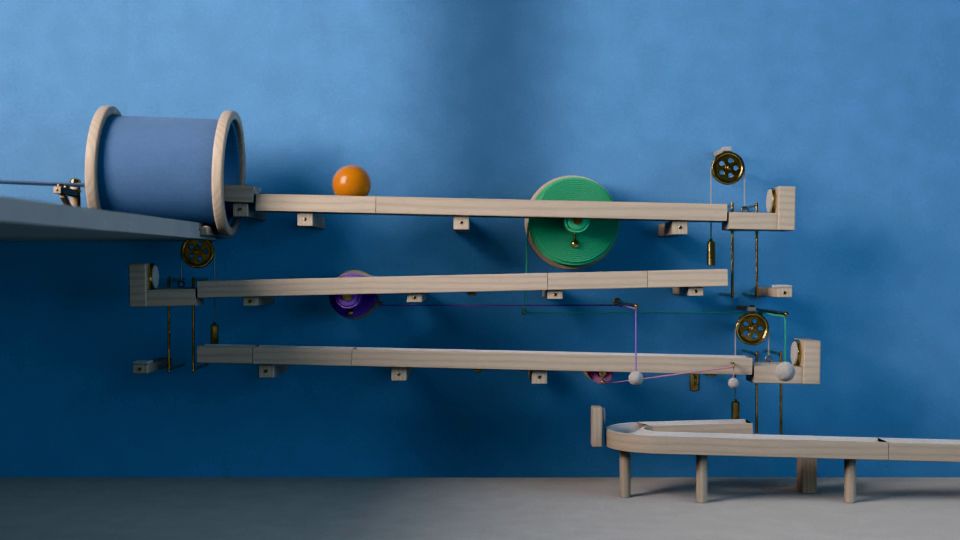
Everything follows the physics of a real table. The ball rolls at 5 to 20 centimetres per second, felt slows it down and it stops wherever physics stops it. The cameras imitate 50 mm and 85 mm lenses, like a macro camera on a workbench.
A render farm of five computers
Every frame is rendered with Cycles, the Blender engine that calculates light as it behaves in the real world, on our own render farm of five computers. An episode renders overnight, using about 1.6 kWh.
The whole workshop lives on a computer, so the entire production is made from a desk.
Sound, material by material
In Kitomo, sound tells the story. Every contact sounds like the two materials that meet:
| Pair | Rolling | Touching |
|---|---|---|
| Ball on felt | a soft “shhh” | “poof” |
| Ball on beech | a wooden “rrrr” | a hollow “tock” |
| Ball on string | a low “rrrum” | a muted “tuuun” |
| Brushing brass | — | a short, high “ting” |
Each sound is placed on the exact frame of the contact: what you see is what you hear. The mix keeps the same volume in every episode, and the journey home is quieter, because the episode fades with the day.
You hear: the ball on felt, on beech and on string, then two brass taps, one after another.
The theme and the sound logo
The theme is a five‑note motif composed by Mario Hernández, played by the music box. The pins on the cylinder are generated from the same score: what you see on the cylinder is what you hear.
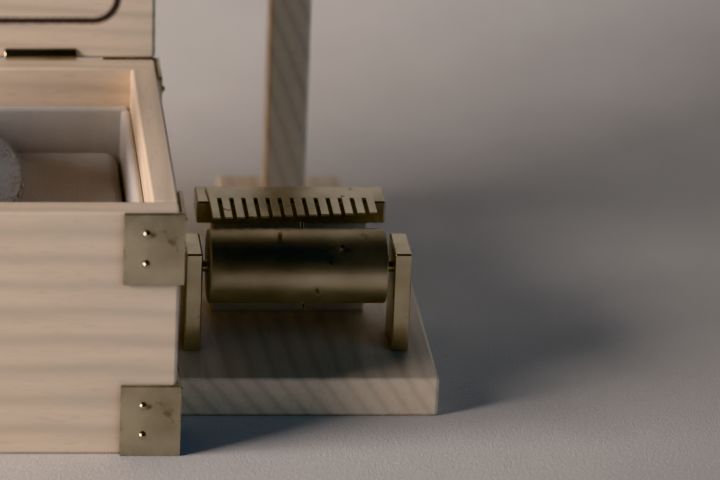
The sound logo says “ki‑to‑mo” with two taps of a beechwood block and a little brass bell.
You hear: five slow notes on a music box.
You hear: two taps on a beechwood block and a little brass bell: ki-to-mo.
Measured, shot by shot
Every episode goes through an automatic check before it is finished:
- each shot lasts 6.5 to 9 seconds on average;
- the ball is visible in 80% of frames or more;
- the light stays steady, with gentle changes;
- the volume stays steady;
- the only written word in the picture is the logo.
Where artificial intelligence is used
| Part | How it is made |
|---|---|
| Picture | Scenes built in code in Blender and rendered on the farm. Every frame comes from the code and the physics of the scene |
| The code | Written by AI agents (Claude, by Anthropic) under the direction of the creator, who approves every style, framing and version |
| Ambient music | Generated with Lyria (Google), block by block. It is selected, edited and mixed |
| Sound effects | Generated with ElevenLabs, chosen by ear and placed on each contact |
| Title voice | A professional voice from the ElevenLabs library |
| Theme | Composed by Mario Hernández |
| Images on this website | All are real renders of Kitomo, made in Blender |
Commitments
- Prompts to the tools describe only the series: its materials, its sounds and its rhythm.
- Only objects appear on screen, and the breath at the start is a sound designed in the studio. The title voice belongs to a professional voice artist who shared her voice in the ElevenLabs library.
- Every episode has its own AI use sheet, with the model, the date and the prompt for each generated piece.
Where the ideas come from
The ideas for each corner come from a wide pool, inspired by wooden automata, Waldorf and Montessori toys, music boxes and marble runs. Mario Hernández chooses every corner, every episode and every final cut.